
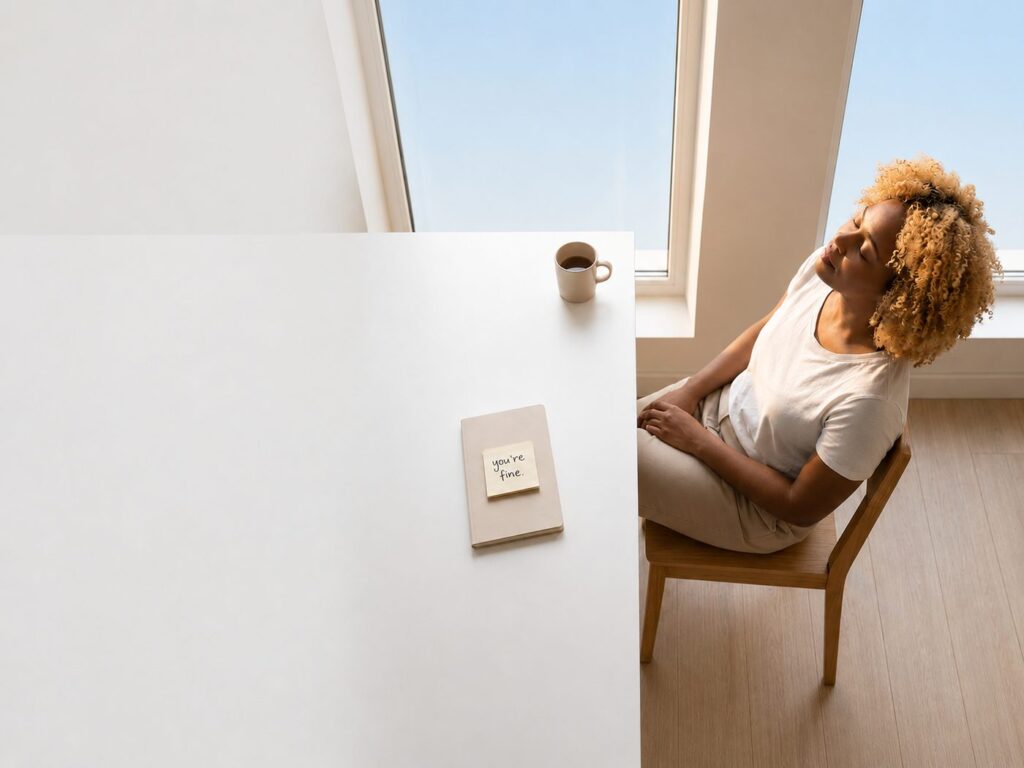
Tired but wired. Exhausted at 3pm, then wide awake at 11pm staring at the ceiling. Anxious for no reason you can point to, guts in a mood, energy that vanished sometime around your last birthday. If that’s you, here’s the blunt truth, said with love: you’re not lazy, you’re not broken, and you almost certainly don’t need another supplement. Most of what fixes this is unglamorous, free, and hiding in plain sight — and a few of the details are genuinely fascinating.
Who it’s for: any woman who’s permanently running on fumes, whose stress, sleep, mood and digestion all seem to have quietly ganged up on her, and who’s tired of being told to “just relax.”
First, the plot twist: your gut is basically a second brain
This is the fact that reframes everything, so let me nerd out for a second. Your gut has its own nervous system — and it contains more neurons than your spinal cord, producing over thirty of the same neurotransmitters your brain uses. Most of your body’s serotonin, the calm-and-steady chemical, is made in your gut, not your head. So when people say “gut feeling,” they’re being more literal than they know. This is why a stressful week wrecks your digestion, and why dodgy digestion leaves you anxious and flat — it’s a two-way street, wired directly to your brain by a great big nerve called the vagus. Once you know that, “stress,” “anxiety” and “IBS” stop looking like three separate problems and start looking like one conversation you can actually join.
The vagus nerve: your built-in calm button
That vagus nerve is the star of the show, and here’s the useful bit — you can talk to it. It runs the “rest and digest” side of your nervous system, and its tone (how well it works) is directly influenced by something you’re doing right now: breathing. This is why slow breathing, humming, singing in the car and a proper belly laugh genuinely calm you down — they’re not woo, they’re nudging a specific nerve. The cheat code: make your exhale longer than your inhale. Breathe in for four, out for six, a few times. That longer out-breath is a direct signal to your body that the danger has passed, even when the “danger” is just your inbox. It’s the fastest free tool you own, and you’ll feel it in about ninety seconds.
The morning light thing (yes, really)
If you do one new thing, make it this, because the science is genuinely wild. Getting daylight in your eyes within an hour of waking suppresses melatonin and gives your cortisol the healthy morning kick it’s supposed to have — which is what actually wakes you up, and what sets the timer for melatonin to rise again roughly sixteen hours later so you can sleep that night. Here’s the mind-bender: fifteen minutes of morning light can shift your sleep timing more powerfully than two hours of the same light in the afternoon. Your eyes are most sensitive to it first thing. Five to twenty minutes outside — on the balcony with your coffee, walking the dog, hanging washing — no sunglasses, and no, through-a-window doesn’t count for much. It is the closest thing to a free energy-and-sleep upgrade that exists, and almost nobody does it.
Your cycle isn’t sabotaging you — it’s informing you
Here’s the reframe that saves a lot of self-blame. Your energy is not meant to be identical every day of the month, and the week before your period — when progesterone drops and you feel flat, foggy, hungrier and more sensitive — is not you failing. It’s biology, running on schedule. The trap is treating that low-energy week like a personal shortcoming and pushing harder, which just digs the hole. The move is to expect it and plan lighter: gentler training, a bit more food, more sleep, more grace. Work with the tide instead of swimming against it. This is the same principle across the bigger hormonal shift too — my take on training and nutrition through perimenopause is this idea on a longer timeline.
The unglamorous stuff that actually works
None of this trends, none of it can be sold to you in a bottle, and all of it outperforms the fancy alternatives. Eat enough. Under-eating is read by your body as a threat, and it will happily keep you anxious and exhausted to “protect” you — a huge chunk of “I’m so tired” is really “I’m so under-fuelled.” Protein at breakfast steadies your mood and energy for hours. Feed your gut bugs with fibre and fermented food, because they’re part of the crew making your calm chemicals. Walk after meals to settle blood sugar, digestion and a racing mind in one go. Guard your evening light as fiercely as your bedtime — dimming the lights an hour before bed does more than any pillow spray. Boring? Completely. Effective? Annoyingly so.
If the “falling apart at 3pm” part is your particular nemesis, my post on sleep and fat loss digs into why that afternoon cliff is usually built the night before.
Your two-minute cheat sheet
You don’t need to do all of this. That’s the fast track to giving up by Wednesday. Pick two, do them until they’re automatic, then add another. Here’s the whole lot in one screenshot-able list:
The wired-but-tired reset checklist
Not all at once. Pick two. Tap to tick as you go.
- Get light in your eyes within an hour of waking. 5–20 minutes outside — no sunglasses, don’t stare at the sun. Sets your whole day’s energy and tonight’s sleep.
- Eat protein at breakfast. It blunts the mid-morning crash and steadies mood far more than a coffee-and-nothing start.
- Breathe out longer than you breathe in. A few rounds of 4-in, 6-out flips your nervous system out of fight-or-flight. Free, instant, works anywhere.
- Walk after a meal. Ten minutes. Helps digestion, blood sugar and the racing-brain feeling in one go.
- Feed your gut bugs. A bit of fibre and fermented food most days — they help make the calm chemicals, no supplement aisle required.
- Protect the wind-down, not just the bedtime. Dim the lights an hour before bed. Light at night is the sleep-thief nobody warns you about.
- Expect the dip before your period — don’t fight it. Lower energy that week isn’t failure. Plan lighter, not harder.
- Eat enough, full stop. Under-eating reads as “stress” to your body. Half of “I’m so tired” is “I’m so under-fuelled.”
The honest bit
Feeling wired and exhausted at the same time isn’t a personality flaw or a supplement deficiency — it’s usually a nervous system that’s been stuck in the “on” position for too long, plus a gut, a sleep pattern and a menstrual cycle that have all been quietly ignored. The good news is that the levers that actually move it are free, simple and already in your body: light, breath, food, movement, and a bit of respect for your own rhythm. Not sexy. Not for sale. Just what works. Start with two things from the list. Your nervous system will meet you halfway.
Want a coach who treats your energy, stress and cycle as part of the plan — not an inconvenience to train through? Come and train with me in Coogee.