
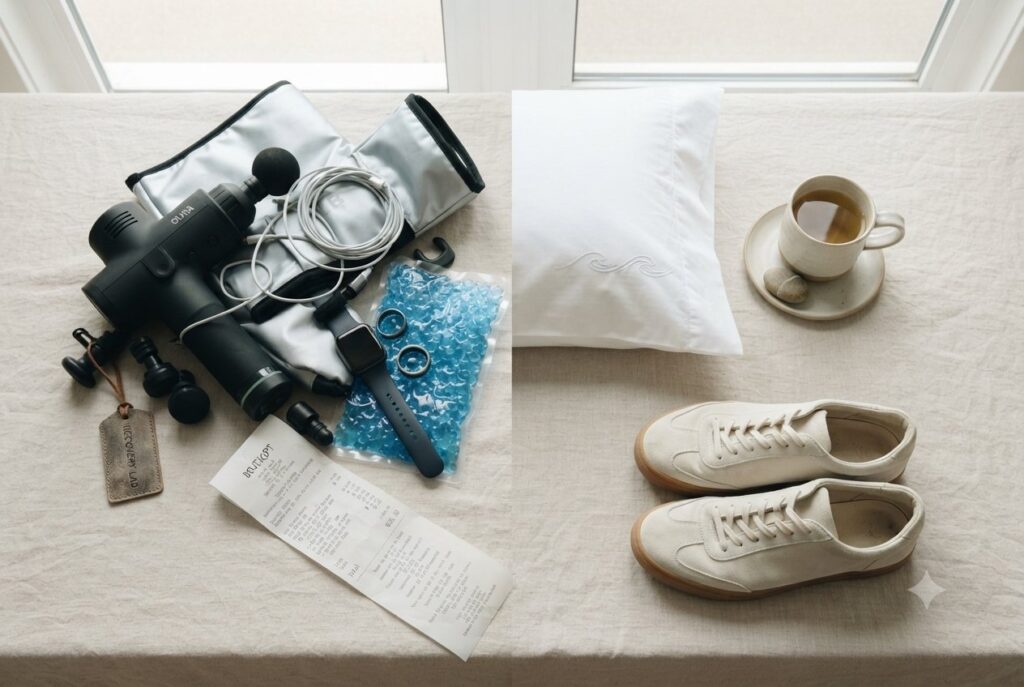
Recovery used to mean a day off and an early night. Now it’s a $600 massage gun, an ice bath you have to plumb in, red lights that make your bathroom look like a nightclub, and a “recovery-optimising” ring that charges more per year than a good pair of trainers. Somewhere along the way, resting became something you had to buy. Here’s the blunt truth, said with love: the recovery that actually works can’t be sold to you, which is exactly why nobody’s advertising it.
Who it’s for: anyone who’s ever felt like they’re not recovering “properly” because they don’t own the gadgets — and anyone eyeing off a cold plunge they can’t really justify.
How resting got a price tag
Recovery is having its main-character moment, and mostly that’s good — we spent years being told to push harder, so “rest is productive” is a welcome correction. But the industry doesn’t make money from you lying down. It makes money from equipment. So rest got repackaged as “recovery tech,” and a free, boring, deeply effective thing got turned into a shopping category. Clever. Not entirely honest.
The stuff that actually works (and costs nothing)
Here’s what genuinely helps your body bounce back, ranked roughly by how much it matters and inversely by how much anyone can profit from it. Sleep. Miles ahead of everything else, and no device recovers you the way seven to nine hours does. Walking. Gentle movement clears more soreness than sitting perfectly still waiting for your muscles to “repair.” Actual rest days. Not “active recovery that’s secretly another workout” — real ones. Eating enough. You cannot recover from training you didn’t fuel; under-eating is the most common reason women feel wrecked all the time. None of that has a checkout button.
The $0 Recovery Score
Five questions. No ring, no subscription, no battery to charge. Tap yes or no, then get your score.
Your recovery score
0/5
Want these to actually stick? That’s exactly what the habit bits in my app are built for.
So are the gadgets a scam?
Not exactly — and I won’t pretend a massage gun never feels nice. But here’s the honest order of operations: the gadgets are the sprinkles, not the cake. A recovery ring measuring your sleep does nothing if you then ignore it and stay up till midnight. An ice bath won’t rescue a week of five-hour nights and skipped meals. If the free fundamentals aren’t in place, the expensive extras are just decorating the problem. Get the boring stuff right first; then, if a gadget genuinely brings you joy, buy it as a treat — not as the fix.
Give it a year and there’ll be an AI that tracks everything — your sleep, your steps, your stress score — and spits out a personalised recovery plan that says: get more sleep, move your body, eat enough. Groundbreaking.
I’ve just given you that plan for the price of reading to the bottom of a blog. The machine will charge you $19.99 a month to tell you the same thing with a nicer chart.
A special word on the “slow down” starter kit
You’ll have noticed “slowing down” and “the art of doing nothing” are suddenly everywhere — and then, right on cue, being sold back to you as a $90 journal, a candle wardrobe and a weekend “rest retreat” that costs more than a flight home to visit your mum. Here’s the cheeky bit: rest you have to purchase isn’t rest. It’s shopping wearing rest’s clothes. Genuine slowing down is free, faintly boring, and available to you tonight — no starter kit required.
Here’s the entire thing in one screenshot-able list — and not a single item has a price tag. Pick two, tap them off as you go, and let the boring free stuff do what the gadgets only promise:
The free recovery kit
Total cost: $0. Pick two. Tap to tick as you go.
- Guard your sleep like it’s a $600 gadget. It’s the only thing that actually repairs muscle and brain overnight — and it’s free. No ring, plunge or gun comes close.
- Walk the day after a hard session. Gentle movement pumps blood through sore muscles and clears the ache faster than lying still. Ten minutes counts.
- Take one properly lazy day a week. Not “active recovery” that’s secretly another workout. A real one. Doing less is the training.
- Eat enough — especially protein. You can’t recover from training you didn’t fuel. “Always exhausted” is very often just “always under-eating.”
- Dim the lights an hour before bed. Light at night is the quiet sleep-thief. Dimming it does more than any pillow spray — and costs nothing.
- Let yourself be bored. Rest you don’t have to buy, book or optimise is the kind that actually works. Stare out a window. That’s it.
The honest bit
You are not recovering “wrong” because you don’t own the equipment. The most powerful recovery tools are sleep, food, walking and rest — all free, all unglamorous, all impossible to put in a shopping cart. Spend the gadget money on better sheets and an earlier bedtime. Your body genuinely can’t tell the difference between a $600 device and a solid night’s sleep, except that the sleep works better. If you want the deep dive on why, my post on sleep and fat loss is the one to read next.
Want training that respects your recovery instead of running you into the ground? Come and train with me in Coogee.