
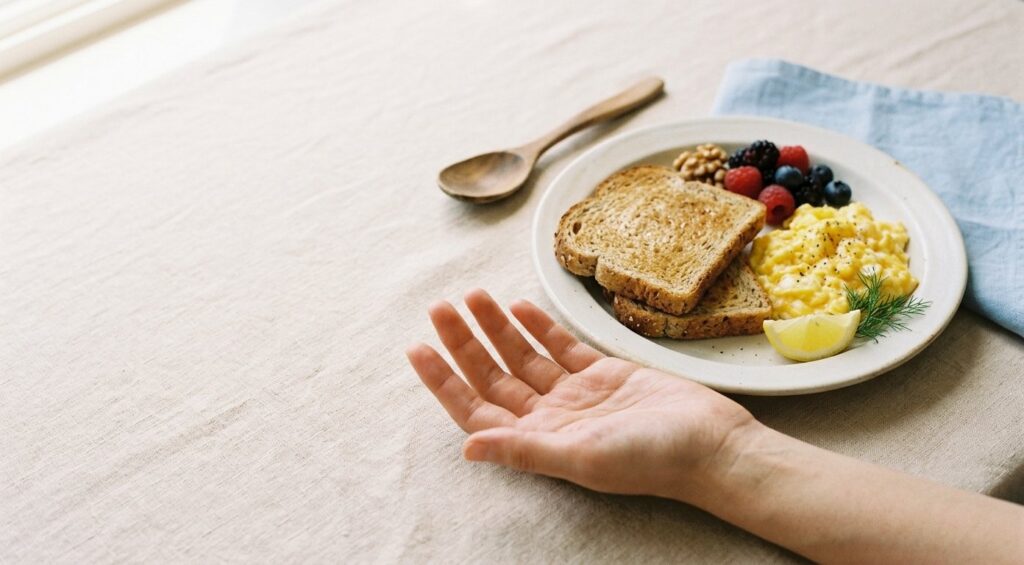
There’s a voice a lot of women carry around all day, quietly narrating. “I’ve been so good this week.” “Ugh, I’ve been so bad.” It shows up at 3pm deciding whether you’re allowed a snack, and again at 9pm deciding whether today counts as a write-off. Here’s the blunt truth, said with love: that voice isn’t discipline. It’s shame wearing a fitness tracker — and it’s the single biggest reason you keep starting again on Monday and never getting anywhere.
Who it’s for: anyone stuck in the earn-it, blow-it, start-again loop, who’s been told the problem is willpower when the real problem is something much quieter, and much heavier.
The lie hiding in “earning” your food
Somewhere along the way, food got moral. Good foods, bad foods. A workout that “earns” dessert. A big meal you have to “make up for” with an extra session. It sounds harmless — motivating, even — but sit with what it actually implies: that you have to deserve the thing that keeps you alive and strong. That your body’s most basic need is a reward you have to qualify for.
You don’t. Food isn’t a prize for good behaviour. It’s fuel, it’s pleasure, it’s how you build the muscle and the energy and the mood that make your life work. A plate of food is not a moral event, and eating it does not make you good or bad — it makes you a person who ate. The moment food stops being something you earn, an astonishing amount of mental noise just… switches off.

Why “starting again Monday” never works
Here’s the genuinely mind-blowing bit, from shame researcher Brené Brown. There’s a crucial difference between guilt and shame, and almost everyone in diet culture has them backwards. Guilt says “I did something bad.” Shame says “I am bad.” Guilt is about a behaviour — and because it’s about a behaviour, you can do something about it. Shame is about your whole self — and that’s the trap.
Because Brown’s research shows shame doesn’t motivate change — it prevents it. Shame is so total that it leaves no room for action; it just makes you want to hide. And what do we do when we feel “I am bad”? We restrict, we punish, we secretly eat, and then, drowning in “I’ve ruined it,” we reach for the only lever we’ve been handed: I’ll start again Monday. Monday isn’t a plan. It’s a shame-reset — and it fails every time, because the shame that broke the week is still sitting there waiting on Monday morning.
Brown puts it perfectly: shame needs three things to grow — secrecy, silence and judgment. Douse it with empathy, and it can’t survive. That’s not a nice sentiment. That’s the actual mechanism for getting out.
I know this loop from the inside
I’m not writing this from the safe side of a desk. For me, it was never really about “earning” food in the obvious way — it went older and deeper than that. I grew up helping in the kitchen, tasting as we cooked, and it also happened to be the room where my parents argued most. So food and stress got wired together early, long before I had words for it — behavioural conditioning I didn’t choose and didn’t understand.
Years later, around thirty, in the middle of a divorce and more stress than I knew what to do with, that old wiring surfaced in a way I couldn’t control. I’ve come to call it my intermittent bulimia — it came and went in waves, quiet for a month or six, then back with a grip for days. It genuinely felt like it wasn’t me at the wheel. Everyone’s version of this looks different; mine hid behind looking fit and “having it handled,” while inside it was a battlefield.
I share this not for sympathy, but because I understand this loop from the inside — the shame, the secrecy, the feeling of being at the mercy of something you can’t reason with. Coming through it wasn’t about more willpower or a stricter plan. It started with understanding that these patterns are learned, not moral failings — and that they can be gently unlearned, with kindness and the right support. That’s the whole reason I coach the way I do: strength over shrinking, never a gram of guilt. Because I know where the other road goes.
The protein magic (fullness isn’t willpower — it’s chemistry)
Now something to actually do tomorrow morning, because reframing shame is the deep work but you need a lever too. Here’s the one that feels like a cheat code: protein is the most filling thing you can eat, and it’s not about willpower — it literally changes your hunger hormones for you. Eating enough protein turns down ghrelin (the hormone that screams “feed me”) and turns up GLP-1 and PYY (the ones that whisper “you’re satisfied”). Your brain gets the “I’m full” signal — chemically, automatically, no white-knuckling.
Read that again, because it’s the opposite of what diet culture taught you. You were told hunger is a test of your character. It’s not — it’s a hormonal signal you can work with, and the simplest lever is front-loading protein, especially at breakfast. Suddenly the 3pm gnawing you’ve been fighting with sheer grit just… quietens, because you fed yourself properly. Not more willpower. Better chemistry. (If you want the how: my guide to eating more protein and these no-cook high-protein breakfasts.)
What breaking the cycle actually looks like
It’s not a better Monday. It’s a kinder Tuesday. The loop breaks the moment you swap shame for guilt’s honest, useful cousin: “that didn’t feel great — what do I want to do next?” instead of “I’m a failure — write off the week.” One keeps you in the game; the other benches you for another seven days. Practically, it looks like eating regularly enough that you’re not deciding from a place of panic, dropping the good-food/bad-food language entirely, saying the hard stuff out loud to someone safe, and treating a wobble as a Tuesday-afternoon course-correction rather than a moral collapse. This is the whole reason I wrote You’re Not Broken — you were never the problem. The system that taught you to earn your food was.
Here’s the whole thing in one screenshot-able list — tap the ones you’ll try:
The kinder reset
Not rules. Permissions. Tap the ones you’ll try.
- Eat before you’re desperate. Regular meals mean decisions come from calm, not from ravenous panic.
- Front-load protein. Let your hunger hormones do the fullness work so willpower doesn’t have to.
- Bin the food morality. No good foods, no bad foods, no “earning” and no “making up for” it later.
- Catch the “I am bad” and swap it. Make it “I did a thing” — then you can actually move forward.
- Say it out loud. Shame dies in daylight. Tell someone safe — empathy is what starves it.
- No more Mondays. If something wobbles, the next meal is the reset. Not next week.
- Talk to yourself like someone you love. You’d never speak to a friend the way that inner voice speaks to you.
The honest bit
You do not have to earn your food, your rest, or your right to feel okay in your body. The whole earn-it, blow-it, restart machine runs on shame — and shame has never once, in the history of the world, made someone healthier or happier. It just makes them quieter about the struggle. The way out isn’t more discipline. It’s more kindness, applied consistently, especially on the days you feel you least deserve it. Start there. Start Tuesday. Start now.
If food and your body feel like a genuine battlefield right now, please know that deserves real support. In Australia, the Butterfly Foundation runs a free, confidential National Helpline on 1800 33 4673 (8am–midnight, 7 days) with counsellors who specialise in eating disorders and body image. It’s a kind, no-pressure place to start. And if you’d like a coach who treats you like a whole person and never trades in guilt — come and train with me in Coogee.